


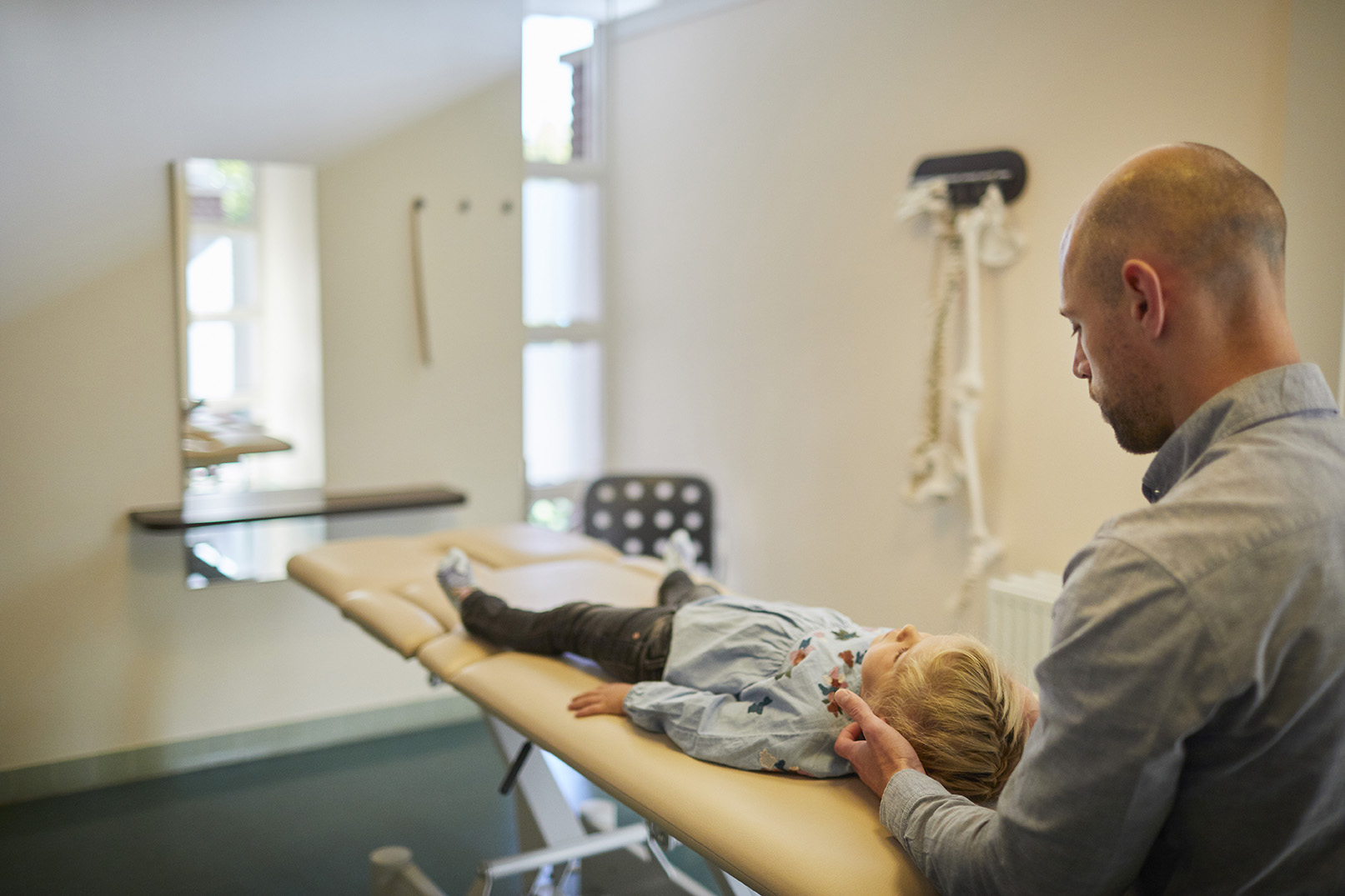
This time, one of the osteopaths, Marc van Leeuwen, explains more about osteopathy, a method of treatment that is gaining increasing interest.
Osteopathy
Osteopathy views the body as a whole consisting of three interdependent and closely connected systems:
– the musculoskeletal system, including bones, the spine, muscles, and joints
– the internal organs with their associated blood and lymphatic vessels
– the skull, meninges, the nervous system, and cerebrospinal fluid circulation
These systems are in contact with each other through the blood circulation, the nervous system, and the membranes present throughout the body that connect everything.
An important lesson from the above is that a disturbance in one system can lead to complaints in another system.
For example: Someone has pain in the right shoulder without a prior fall or overexertion. An examination reveals that bursitis in the shoulder is responsible. However, instead of opting for a local treatment of this bursa, an osteopath will first ask why the bursa became irritated. It could be that the cause lies in a loss of mobility in the membranes surrounding the liver, which are located high on the right side of the abdomen. Tension in these membranes and all their connections eventually exerts more pull on the right collarbone and the right shoulder girdle, putting extra pressure on the bursa. It then takes very little additional strain on this shoulder for bursitis to result. The treatment will then focus on the membranes around the liver, rather than primarily on the shoulder. The shoulder recovers naturally once the membranes around the liver have regained their normal tension.
“I am becoming increasingly enthusiastic about osteopathy due to my experiences over the last few years. There are sometimes striking relationships between a patient’s complaint and the actual cause, which is often located in a completely different part of the body and has frequently been present for much longer. A certain trigger—which can be anything, such as a fall or an emotional event—can cause this to escalate into the patient’s eventual complaint,” says Marc.
Who is osteopathy for?
There are countless examples of disorders arising in deeper structures of the body that lead to musculoskeletal complaints, such as back or neck pain, but headaches, chronic sinus problems, or bursitis can also be the result. In fact, such a disorder can lead to consequences anywhere in the body.
Osteopathy can therefore help with a wide range of complaints, but it is particularly useful when other treatments offer insufficient relief, or if complaints keep recurring. In such cases, a different perspective is appropriate.
The study to become an osteopath for physiotherapists takes six years; a qualified osteopath can be recognized by the title D.O.-MRO. Treatments are fully or partially reimbursed by almost all insurance providers.
Marc van Leeuwen is an osteopath, D.O. – MSc. Ost.
Article about Osteopathy, including case study example, de Ahrenberger, 2009

