


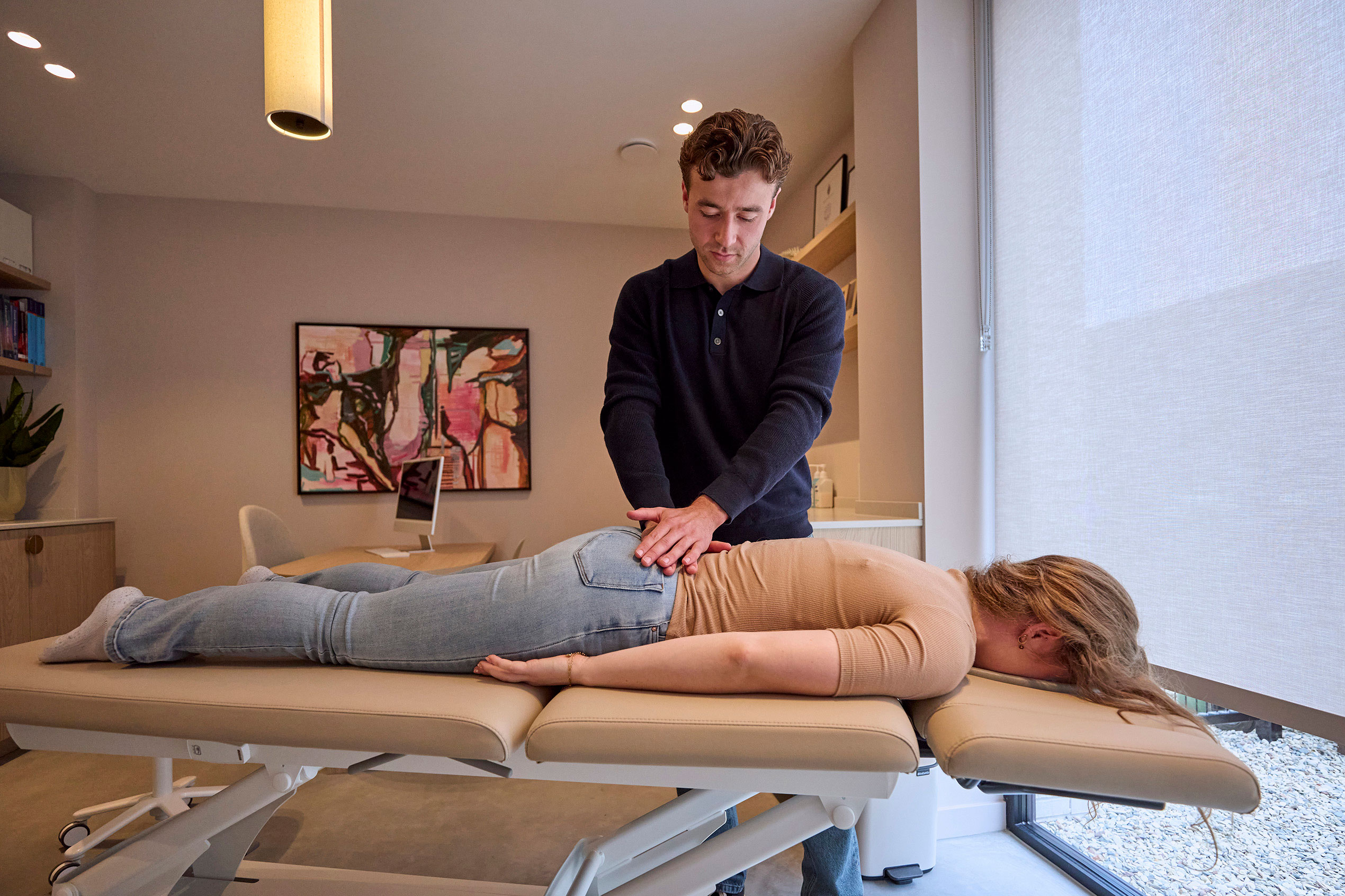
Recently, I saw a 43-year-old woman with chronic low back pain. Years ago, a hernia between the fourth and fifth lumbar vertebrae was diagnosed, for which she underwent surgery at the age of 31.
Yet the symptoms kept returning: pain in the right buttock radiating to the lower leg and foot. Many people quickly attribute new symptoms to a previous hernia. This is understandable, but not always the full explanation.
The question I therefore ask myself is: why did this hernia develop at the time, and which factors are still playing a role now?
In this patient, I initially found increased basal tension in the right crus of the diaphragm, a structure that attaches to the lumbar vertebrae. Additionally, the diaphragm plays an important role in the circulation of the lymphatic system, among others. In my experience, reduced mobility of the diaphragm can have a significant influence on the functioning of the lower back.
It is my conviction that a hernia usually does not arise from a single factor. Especially at a relatively young age, I wonder which underlying factors contributed to its development. In addition to the increased tension of the diaphragm, I also found an intra-osseous motion restriction of the sacrum. My experience is that in chronic back pain, there is rarely a single isolated motion restriction, but rather multiple structures influencing each other.
Furthermore, I always look for the event or strain that caused the body to start compensating. We were also able to trace that well in this case. For me, the combination of the patient’s story, the physical examination, and the motion restrictions found is essential to understanding the primary dysfunction.
After the first treatment, there was a temporary increase in symptoms, a reaction I regularly see. This was followed by a clear improvement, and within four treatments spread over three months, the back and radiating pain had disappeared.
Of course, this is a single case and every patient is different. Does this mean that I treat the diaphragm and the sacrum for every chronic back complaint? Certainly not. That is precisely what makes the work of an osteopath so interesting. I do not work according to a standard protocol. For me, every treatment begins with identifying the primary dysfunction: the structure showing the greatest loss of motion at that moment.
When that primary restriction decreases, I often see the body become better able to initiate the recovery process again.
That is precisely why, in the case of chronic back pain, I do not only look at the place where the pain is felt, but I investigate which structure is preventing the body from functioning optimally. For me, that is the core of osteopathy.

